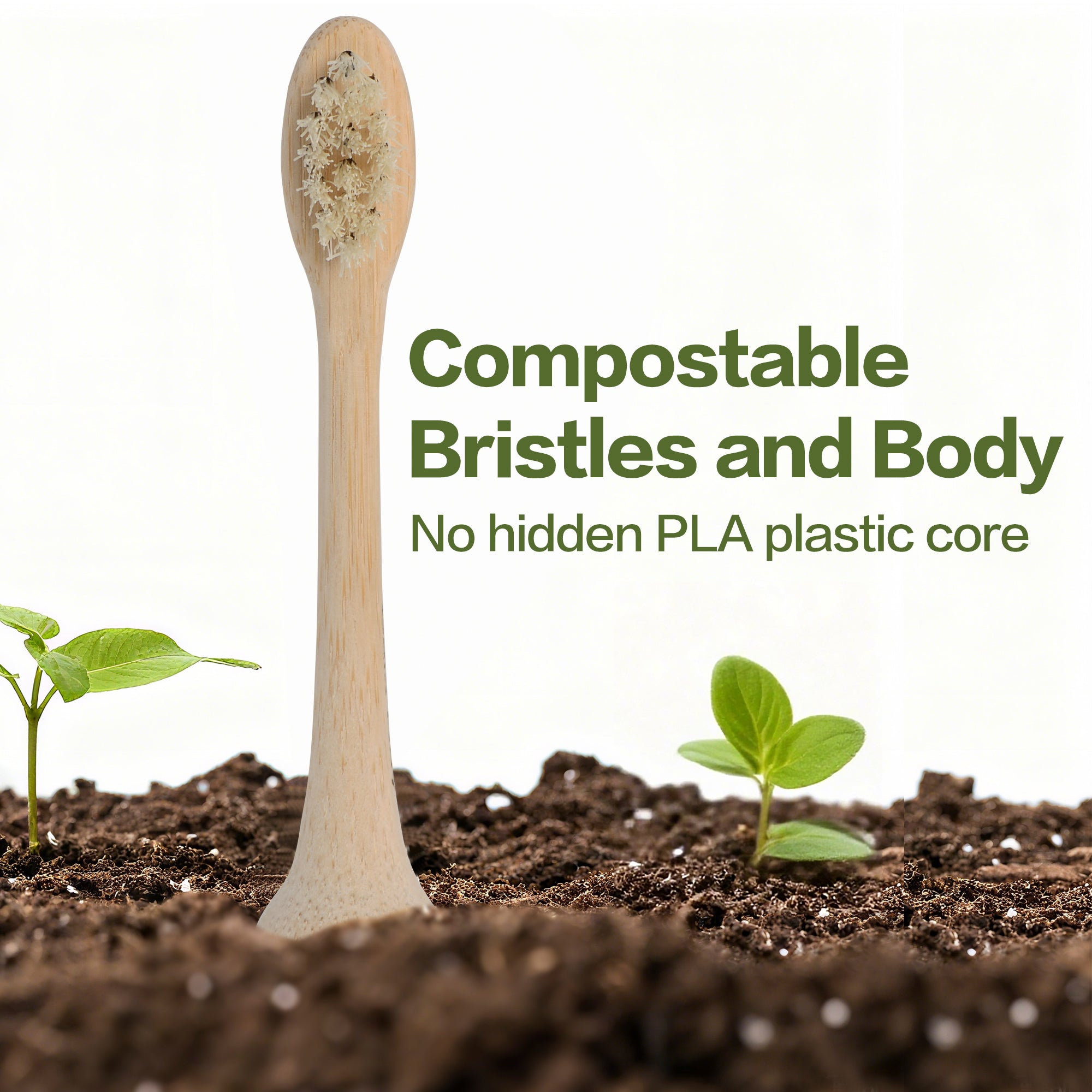

If you've ever bought a 10-pack (or 12-pack or family-pack of natural bristle toothbrushes) of our toothbrushes for the whole family, for guests, for stocking up so you're never caught reaching for something plastic then you've probably also looked closely at one and wondered exactly how those bristles are staying put.
That question comes up a lot, so let's go through it properly. And let's talk about what's changing in some of our bamboo and horsehair and bamboo and boar hair 10-packs.

How the Bristles Are Actually Attached
Every Gaia Guy toothbrush holds its boar or horsehair bristle tufts in place with a small metal staple, pressed into a hole in solid bamboo.
No glue. No resin. No adhesive of any kind in the brushing end of the toothbrush.
Up until now, that staple has always been copper.
Why copper:
- It's one of the most recyclable metals there is, as a material in general
- It's low-impact to produce compared to most metals
- It's stood up well as a way to secure natural bristle for a long time
- It pairs sensibly with a product that's otherwise entirely natural — bamboo handle, boar or horsehair bristles, copper staple, nothing else. (Some bamboo electric replacement toothbrush head versions do have a water-based coating for additional smoothness and water-resistant qualities).
To be fair, that recyclability is more about copper as a material than something that plays out staple by staple. Nobody's fishing a single tiny staple out of a worn toothbrush to take to a scrap yard (Well there will be some that like to do that). In practice your old brush is going in the compost (or upcycled into plant marker) or the trash, staple and all. Copper just means whatever footprint that one staple has is about as small as a metal footprint gets.
Here's the tradeoff, though. Copper is a relatively soft metal. Over months of daily flexing, hot water, and toothpaste exposure, the bend that's gripping each bristle tuft can occasionally loosen enough that a bristle or two works free. Not the norm. But it happens — soft metal flexes, and flexed enough times, it can give a little.
What's New: Nickel Alloy Staples in Select 10-Packs
So we're introducing 10-packs with nickel alloy staples instead of copper.
Two things change, and both work in your favor:
- Nickel alloys hold their shape better under repeated flexing than soft copper does.
- Nickel alloys resist the tarnish and corrosion that softer metals develop in a damp, daily-use environment.
A staple that deforms less and corrodes less is a staple that grips longer. Fewer loose bristles over the life of the brush. That's the entire idea behind the change. Same construction, same no-glue approach, just a harder-wearing staple in the format people tend to buy when they want brushes that'll hold up over the long haul.
To be clear about the rest of the lineup: copper staples aren't going anywhere. They remain standard across the rest of our toothbrushes and are still a perfectly good, sustainable choice. The nickel alloy version is simply the upgraded option, starting with select 10-packs, for anyone who wants the most bristle-retentive brush we make.

How Most Toothbrushes Attach Bristles (And Why That Matters)
Here's something most people don't know, eco-conscious or not: the metal staple is the original, time-tested way the entire toothbrush industry attaches bristles, going back to some of the earliest mass-produced brushes. It's not a niche, crunchy, bamboo-brand thing.
The bristle tuft is folded in half, a small rectangular metal staple is driven through the fold, and the staple wedges into a hole. In manufacturing terms it's usually called an "anchor," and it works by friction: the staple is slightly wider than the hole, so it bites into the material around it and holds tight. Major manufacturers, from budget grocery-store brushes to brands like Lion in Japan, build their standard bristle toothbrushes exactly this way.
What varies, brush to brush, is the metal the staple is made from:
- Aluminum is common in mass-market plastic toothbrushes, since it's cheap and easy to form at scale.
- Stainless steel, nickel-iron, and nickel alloy anchors show up where manufacturers want more durability or corrosion resistance.
- Copper is what we've always used, since it's one of the most genuinely recyclable metals out there and pairs with an all-natural build.
- Nickel alloy is the new option in select 10-packs, chosen specifically for extra hardness and corrosion resistance.
There is a newer alternative gaining ground in parts of the industry, mostly on electric brush heads and some synthetic-bristle designs: a melt-bonding process (sometimes branded "PTt") that fuses the ends of plastic nylon filaments together under heat and pressure, with no metal anchor at all. It's a genuinely clever bit of engineering, but it only works because nylon is a thermoplastic that melts and re-fuses. Natural boar and horsehair bristle doesn't melt that way, so this method isn't an option for a brush built around real animal-hair bristle. For a brush like ours, a metal staple really is the proven, available method.
So when people ask "are toothbrush bristles glued in," the honest answer for almost any bristle toothbrush, ours included, is no. Gaia Guy toothbrush bristles staked in with a metal staple or anchor, the same basic method the whole industry has relied on for generations. Glue shows up far less than people assume. What actually separates one brush from another is the staple material, and whether anything else in the handle involves adhesive.

That second part is where we're upfront: our handles are a single solid piece of bamboo, no glue anywhere near it. We do have one stand-up toothbrush version with a laminated handle, and our Sonicare-compatible bamboo toothbrush heads include a small bamboo piece glued into the plastic base needed to fit electric brush handles. Neither of those glue points ever touches your mouth. These are structural, nowhere near the bristle. We think that distinction matters, so we're not going to gloss over it.
"A Bristle Came Loose Right Out of the Package — Is That Normal?"
Sometimes, yes, especially with a brand-new brush.
Here's why: hot water hydrates and softens natural bristle, and a brand-new tuft hasn't had that happen yet. A bristle or two settling and working loose on first use is a known, fairly common quirk of natural bristle set in a metal staple. It's just a different material behaving differently than the synthetic nylon most people are used to.
Two things that help:
- Soak the bristle head in hot water for a minute or two before that first brush. This softens and seats the bristles, and tends to shed any truly loose ones before they end up in your mouth.
- Give the bristles a gentle tug or two after soaking, before you start brushing. If anything's going to come loose, better it happens over the sink than mid-brush.
Even with both steps, an occasional loose bristle can still happen. It's a natural material, not a uniform synthetic one, so there's some variation tuft to tuft.
Where we draw the line on a real defect: one or two individual bristles coming loose is normal wear for any natural-bristle, staple-set brush. A whole clump or tuft coming out together is not normal — and that's on us. If that happens, get in touch and we'll make it right.
"Does the Staple Affect How the Brush Feels or Cleans?"
No. The staple is fully buried in the bamboo and bristle base — it never makes contact with your teeth or gums.
Whether a brush has a copper staple or the new nickel alloy one, the actual brushing experience comes down entirely to the bristle type: boar for a firmer, scrubbier clean, horsehair for something gentler.
"Is Nickel Safe to Have in My Toothbrush?"
The staple is enclosed in the bamboo handle and doesn't contact your mouth during normal use, so direct exposure isn't really the concern it might sound like.
If you have a known nickel allergy and want to rule out any contact whatsoever, our standard copper-stapled toothbrushes remain fully available across the rest of the lineup.
"Will the Nickel Alloy Staples Still Compost Like the Copper Ones?"
Same answer either way: the metal portion won't break down, but the amount in a single staple is small enough that tossing the whole brush into a home compost pile generally won't cause problems for your soil or plants.
Realistically, almost nobody is digging a single tiny staple out of a worn-out toothbrush before composting it — and you don't need to. Just compost the whole thing as-is. Full instructions for breaking down the rest of the brush are in our composting guide.
What's in the New 10-Packs
The nickel alloy staple rollout is starting with select 10-packs — the format most people reach for when stocking up for the household or buying in bulk, and exactly where a more durable staple matters most over a longer stretch of daily use.
If the response is good, expect it to spread further across the range. In the meantime, both versions share everything else that makes a Gaia Guy toothbrush what it is: solid bamboo handle, no glue or adhesive near the bristles, and your choice of boar or horsehair bristle.
Related reading:
- Natural Toothbrush Bristles Explained: boar, horsehair, sourcing, and staples
- How to Compost Your Bamboo Toothbrush (Including Bristles!)
- Boar and Horsehair vs Nylon Toothbrushes: What Does Science Really Say?
- Your Ultimate Guide: FAQs About Gaia Guy Bamboo & Natural Bristle Toothbrushes
- How to Reduce Microplastics in Daily Life